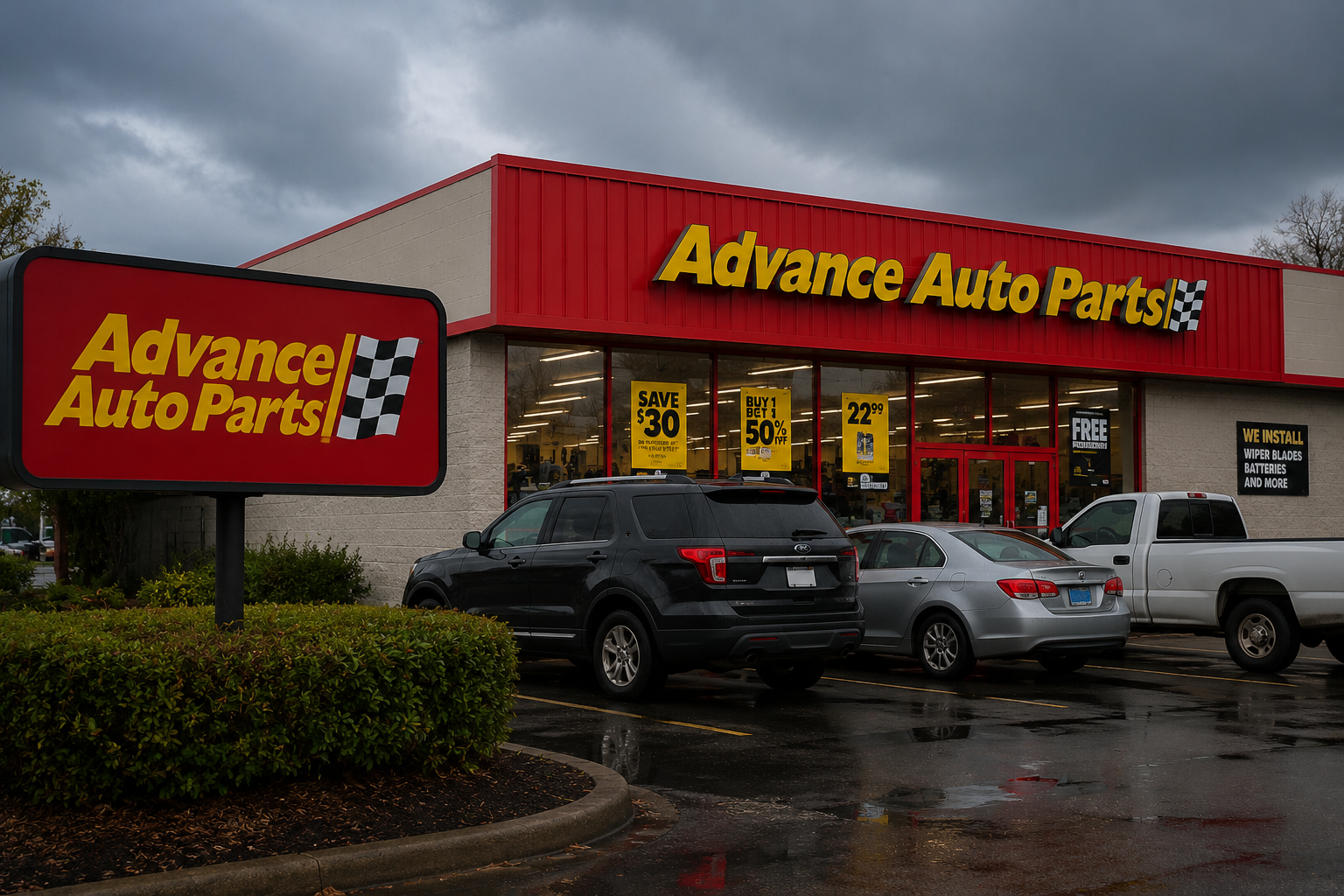
Advance Auto Parts reported an earnings beat on Thursday that the market treated like a miss. Reported EPS came in at $1.03, well above the roughly $0.81 Wall Street had modeled, while revenue landed at $2.000 billion against consensus near $2.04 billion. The stock (AAP) fell from a close of $56.18 the day before the print to $42.39 by the end of the session, erasing roughly a quarter of its value. Two trading days later, at $42.58, it had not meaningfully recovered.
That gap between the profit line and the stock price is the story. Underneath the revenue shortfall, the underlying business improved by some of the widest margins the company has cited in years. Gross margin rose about 240 basis points year over year. Operating margin roughly doubled to about 5.6%. Year-to-date free cash flow turned positive, climbing $120 million, and net leverage came down to roughly 2.1 times. On almost every measure of how efficiently the company converts sales into cash and profit, the quarter marked genuine progress.
A Comp Miss With a Demographic Label
The problem is the top line, not the bottom line. Comparable sales fell short of expectations, and management, according to secondary coverage of the earnings call, attributed the weakness substantially to the company's heavy exposure to lower-end and do-it-yourself customers. That is management's framing, not an independently verified diagnosis, and it casts the shortfall as a demand-side problem tied to a specific customer cohort's spending power rather than an execution failure inside the company's stores or supply chain.
If that framing holds, it is a more troubling explanation for investors than a simple operational stumble, because it points to a segment of the consumer base that Advance Auto Parts does not control and cannot easily out-execute its way around. A margin miss from poor inventory management can be fixed with better processes. A revenue miss tied to a customer segment pulling back discretionary auto spending is a demand problem that shows up again next quarter unless that consumer's finances improve.
What the Market Is Actually Pricing
A quarter-sized drop in a single session is not a verdict on margin quality. It is a verdict on what the market believes that margin and cash-flow improvement is worth if the customer base underneath it keeps shrinking. Sell-side analysts did not treat the move as a pure overreaction to be faded: price targets were cut after the print despite the EPS beat, meaning at least part of the Street shares the market's skepticism rather than dismissing the selloff as noise. That matters because the reaction was not confined to retail investors reading a headline revenue miss without digging into the margin story — some of the professional analyst base recalibrated too.
A Company-Specific Signal, Not a Sector One
The reaction elsewhere in auto parts retail supports the idea that this is an Advance-specific issue rather than a read-through for the industry. AutoZone and O'Reilly Automotive both fell in sympathy the same day, but by far smaller amounts, roughly 4% or less. If the market believed the comp weakness reflected a broad pullback in DIY auto spending across the category, its larger, better-capitalized peers would likely have moved by more. The muted sympathy move suggests investors are pricing this as specific to Advance Auto Parts' customer mix and market position, not a warning sign for auto parts retail generally.
If the margin, cash-flow and leverage gains hold while comparable sales stabilize, Thursday's reaction will look like an overcorrection built on a single top-line number. If comps keep eroding along the demographic lines management described, the operational progress will not matter, because the customer base funding it will keep shrinking. The company's next quarterly comparable-sales figure is the number that settles which case was right.