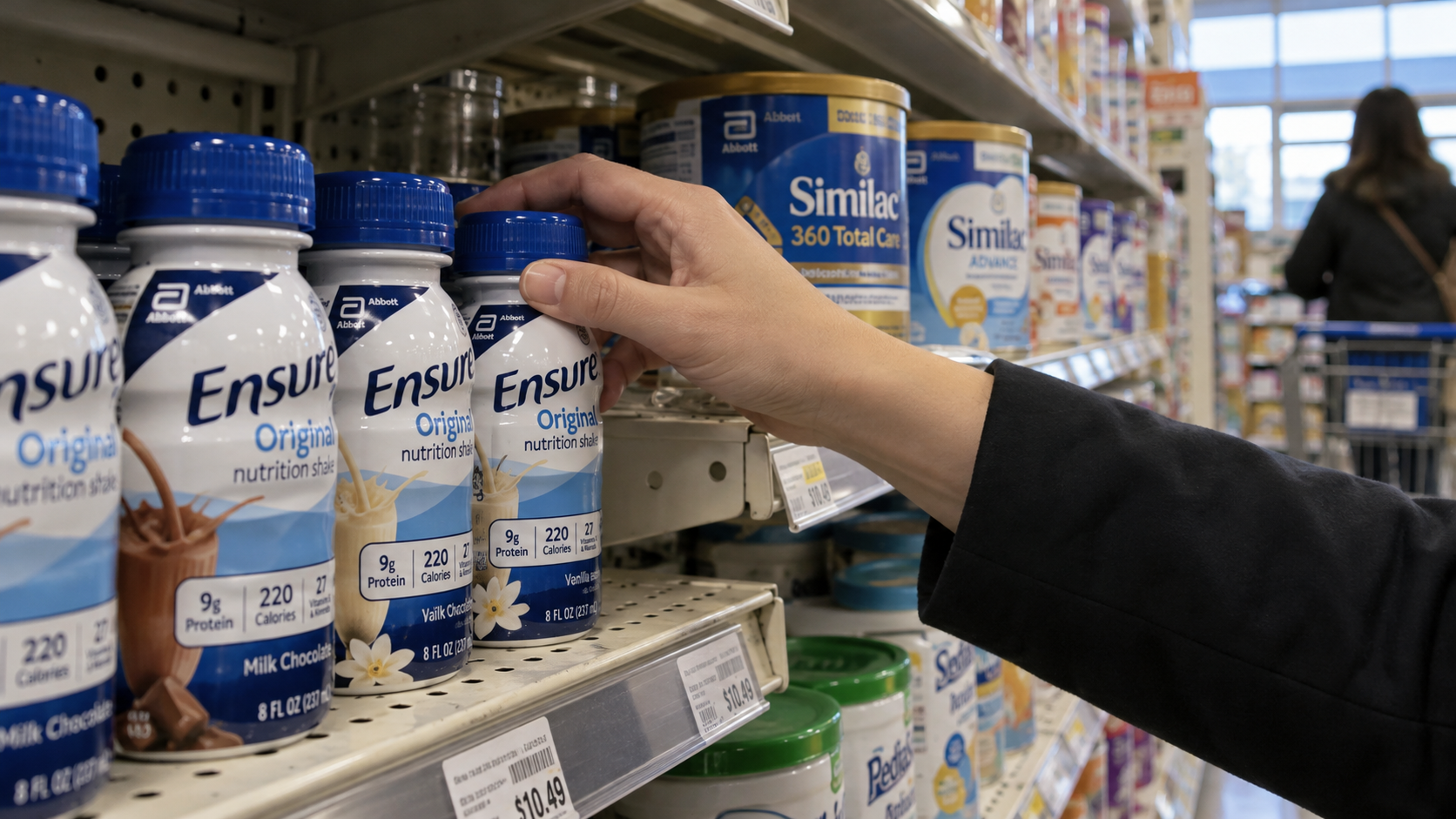
The company said it will separate Similac, Ensure and its other nutrition brands as an independent public company by the end of 2027. It also lowered its 2026 sales growth forecast to about 6% from a range of 6.5% to 7.5%, with weakness in medical devices behind the cut.
Abbott told investors two things at once on Wednesday: it is splitting in two, and its growth is slowing. They are not the same message.
The company said it plans a tax-free distribution that will make its Nutrition business, which includes Similac, PediaSure, Pedialyte, Glucerna and Ensure, an independent public company, with completion expected by the end of 2027. The unit has about $8.5 billion in annual sales, about 16,000 employees and 14 plants. Robert Ford, Abbott's chief executive, said the separation "will benefit both companies." Abbott said the separation will not affect its 2026 or 2027 guidance.
The quarter
Third-quarter sales were $13.013 billion, up 14.5% as reported and 7.0% on a comparable basis. Adjusted earnings were $1.42 a share, in line with the LSEG consensus. Net earnings were $920 million.
The gap between 14.5% and 7.0% is 7.5 percentage points, and it points mostly to the Exact Sciences acquisition. Currency slightly reduced reported growth; excluding currency, growth was 14.8%. Diagnostics sales rose 47% to $3.31 billion as reported. Nutrition sales were $2.26 billion, up 5.1%.
Where the weakness is
The business Abbott is keeping is the one that missed. Medical Devices sales were $5.83 billion, up 6.9% as reported and 7.8% on a comparable basis, below an analyst estimate of $5.88 billion. Continuous glucose monitor sales rose 7.3%. The company cut its 2026 sales growth forecast to about 6% from a range of 6.5% to 7.5%, a reduction that Ford tied to two businesses, electrophysiology and diabetes care.
The shares were down 3.64% at $98.72 at about 1:46 p.m. Eastern, from a close of $102.45. The range of the day ran from $97.67 down 4.7% to $106.35 up 3.8%, so the shares traded on both sides of Tuesday's close.
What the spin changes
Splitting off nutrition leaves a company built around devices, diagnostics and medicines. That makes the devices growth rate, which is now below what Abbott had forecast, the center of the remaining company's case. Abbott said the remaining company will have accelerated sales growth and an expanded margin profile.
The spin also leaves open questions that investors will need answered: how debt will be divided between the two companies, which one will carry litigation tied to infant formula, and whether devices can sustain comparable growth near 8% once nutrition is gone while continuous glucose monitors are growing below that rate.
Two readings
One reading is that Wednesday's decline is appropriate. A guidance cut tied to the largest remaining business, announced alongside a long separation process, deserves a lower price than a clean quarter would.
The other reading is that the spin releases value that a conglomerate structure hid. Nutrition and devices are different businesses with different investors, and the market may reward the two parts separately when the process nears completion.
What to watch
A Form 10 registration for the new company, which should show its financials and capital structure; the allocation of debt and legal exposure; fourth-quarter device growth; and Abbott's 2027 outlook. Evidence that devices are growing near 8% on a comparable basis again would support the case for the retained business.