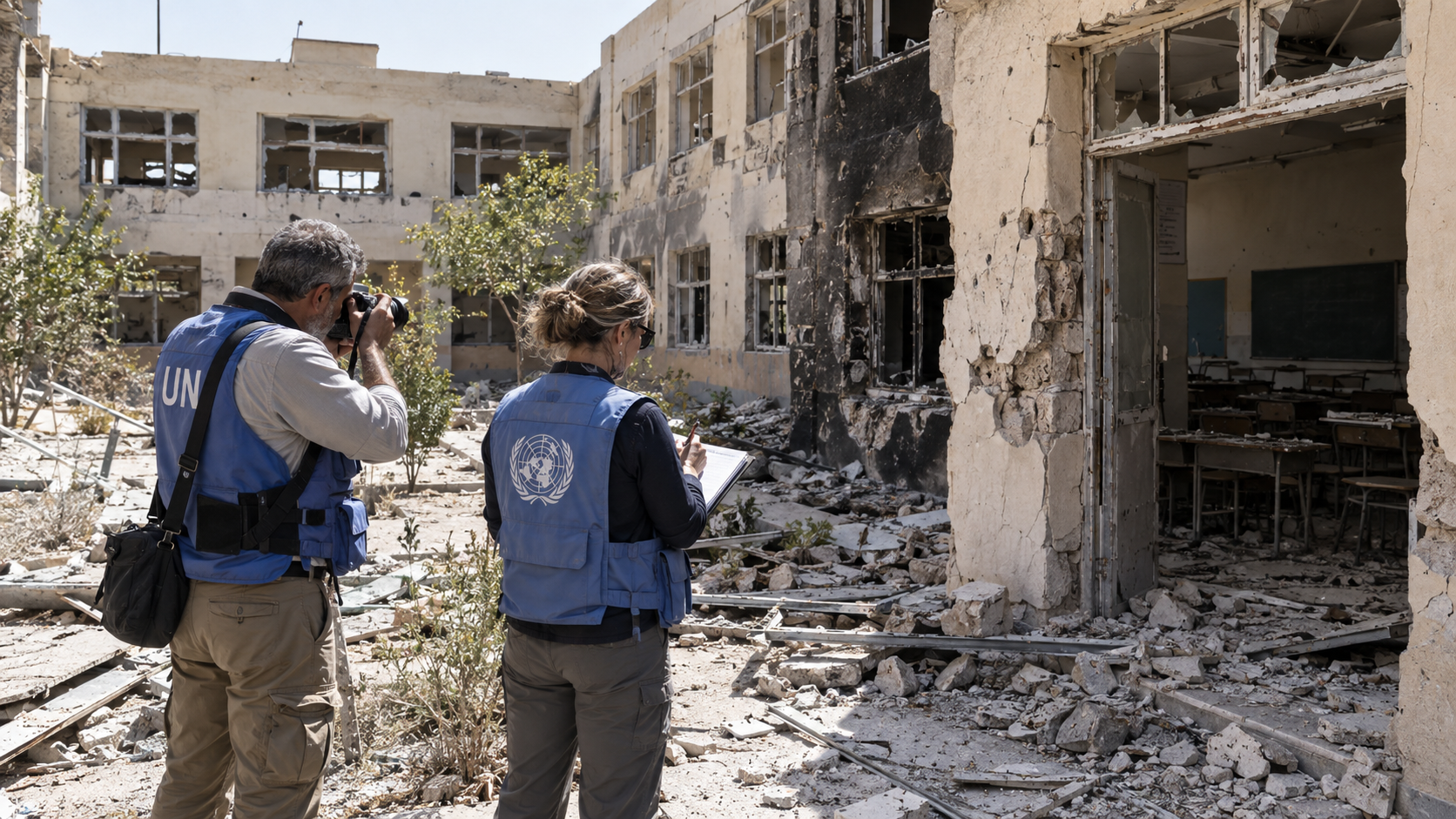
A fact-finding mission's conclusion that two American strikes killed at least 178 civilians has drawn a flat rejection from the White House, adding a new diplomatic fault line to a war already reshaping global energy markets.
A United Nations Independent International Fact-Finding Mission has found reasonable grounds to believe that two U.S. strikes carried out in Iran on , targeting a school in Minab and a sports complex in Lamerd, amounted to indiscriminate attacks constituting war crimes. The mission's finding puts combined civilian casualties from the two strikes at a minimum of 178, including roughly 120 schoolchildren at the Minab site. The White House rejected the finding directly. Deputy Press Secretary Anna Kelly said on September 18 that "the only party in this conflict that has committed war crimes is the Iranian regime, which has murdered thousands of its own people, killed Americans overseas, executed acts of terrorism in the Strait of Hormuz, and launched indiscriminate attacks against its neighbors in the region."
The two sides do not even agree on basic attribution for one of the two strikes. The UN mission attributes the Lamerd sports-complex strike to U.S. forces, while U.S. Central Command has denied carrying out that particular strike, an unresolved contradiction sitting at the center of an already contentious dispute. Neither the mission's full report nor a formal Pentagon accounting of the strike has been made public, leaving the contradiction unresolved.
The dispute lands at a moment when the broader war between the United States and Iran is already reshaping global energy markets in ways investors are tracking closely. Continued disruption around the Strait of Hormuz, one of the world's most important oil chokepoints, has pushed tanker freight rates to records and forced Saudi Arabia to reroute crude shipments at significant added cost, while diesel prices in the United States have climbed to their highest level on record. Those effects trace to the war's physical disruption of shipping and refining capacity, not to this specific diplomatic dispute over the February strikes, and the UN finding itself has produced no discernible move in markets.
What the exchange does add is a new and public fault line in how the war's conduct is being judged internationally, at a moment when the war's duration is itself a live question shaping expectations for oil and fuel prices well into the fourth quarter. Investors focused on the war's economic spillover will want to watch whether the dispute over the UN finding affects diplomatic efforts already under way to wind down the conflict, since any acceleration or extension of the fighting carries direct implications for the energy costs already weighing on manufacturers, shippers and consumers.