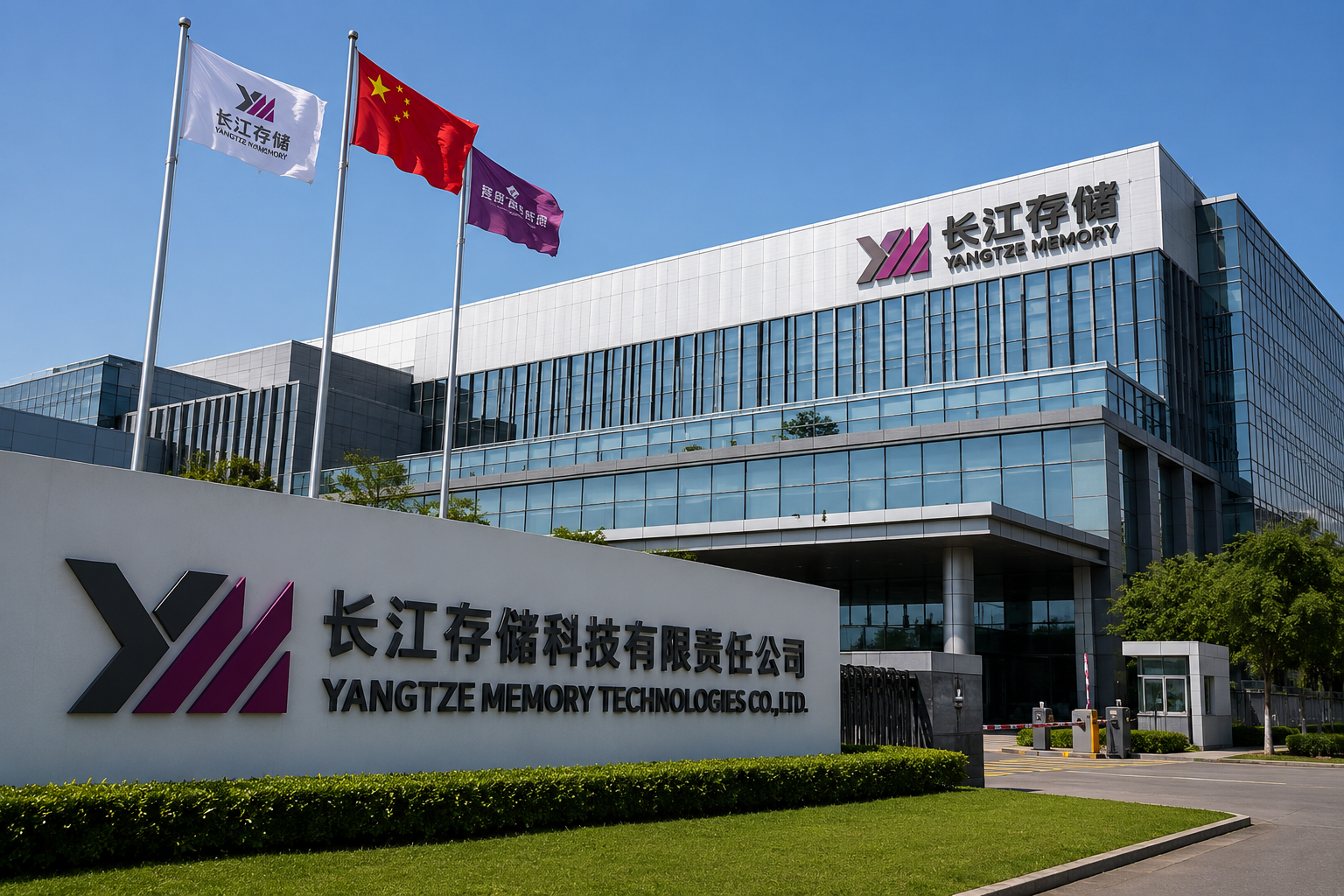
Yangtze Memory Technologies Co.'s parent filed to raise roughly $4.9 billion on Shanghai's STAR Market, reported August 21-22 by Bloomberg and the Wall Street Journal, and said the money is earmarked to expand flash-memory production capacity. That single fact sits awkwardly next to the trade that has defined US memory stocks all year: an AI-driven DRAM and NAND shortage that has taken Micron from a 52-week low of $114.25 to a high of $1,255, roughly an elevenfold move, with Western Digital and SanDisk re-rating sharply alongside it.
Every memory upcycle in the industry's history has ended the same way: prices rise, capital floods in, new capacity gets built, and the shortage that justified the multiple expansion turns into the glut that ends it. YMTC's filing is state-backed, well-funded and explicit about its purpose. It is, in miniature, the mechanism that has repeatedly capped memory cycles before. The question is not whether that mechanism exists. It's whether it can move fast enough to matter to this cycle.
It can't, not yet. New fab capacity takes 18 to 24-plus months to reach volume yield. A capital raise announced in August 2026 does not translate into wafers shipping at scale before 2027 at the earliest, and likely later. That lag is the working thesis of this article: if the shortage narrative behind this year's re-ratings is a 2026-2027 phenomenon, a raise that funds output arriving in 2027-2028 is a future risk to that thesis, not a present one. No move in Micron, Western Digital or SanDisk shares should be read as a reaction to this filing, because the capacity it funds isn't capacity yet. It's a construction plan with a Shanghai listing attached.
A second constraint narrows the threat further. YMTC remains on the US Entity List, which restricts its access to advanced-node equipment and complicates its ability to win customers in markets where US-linked supply chains dominate. That doesn't neutralize the eventual capacity, but it does narrow where it can compete. Output built under export restrictions is more likely to compress pricing in China-facing and price-sensitive channels first, rather than immediately displacing the advanced-node, data-center-grade mix that has driven Micron's re-rating. Whether that separation holds once volumes actually ship is unresolved and depends on execution YMTC hasn't yet demonstrated.
Put together, the lead time and the Entity List restriction point the same direction: this is a 2027-2028 risk to underwrite against, not a 2026 catalyst to trade around.
The named alternative view deserves its own weight rather than a footnote. Lead time has never been the mechanism that ends memory cycles; supply arriving on schedule is. Every prior memory glut was visible in capital-raise and capex data well before it hit pricing, because that is exactly how long semiconductor capacity takes to build. A $4.9 billion raise explicitly tied to flash-memory expansion is precisely the kind of concrete, checkable data point that has historically preceded pricing power eroding once the capacity came online. Treating an 18-to-24-plus-month runway as permanent insulation, rather than a delay with a known length, is itself a risk to the bull case. History rhymes here more than it repeats; no two memory cycles have unwound on identical timelines, and that pattern is a guide, not a guarantee.
What resolves this is not the filing but what follows it: how quickly YMTC converts $4.9 billion into qualified, shipping wafers across 2027 and 2028, and whether Entity List restrictions keep redirecting that output toward China-facing and price-sensitive channels rather than the advanced-node, data-center-grade mix underwriting Micron's re-rating. Investors long Micron, Western Digital or SanDisk aren't being tested by this week's headline. They're being tested by capacity data still two years out.