Drone attacks on Saudi Arabia's main pipeline bypass have forced more crude through the Strait of Hormuz, pushing the cost of hiring an oil tanker to a record and threatening to keep gasoline prices elevated even if crude itself gets cheaper.
The war disrupting Middle East oil supplies has created a shortage that extends beyond crude itself to the ships that carry it. Drone attacks earlier this month shut down Saudi Arabia's East-West Pipeline, the kingdom's main route for moving crude from the Persian Gulf to the Red Sea port of Yanbu without passing through the Strait of Hormuz. With that bypass offline, more Saudi crude has been forced back through the strait and onto a global tanker fleet that was already stretched thin, and the cost of hiring a very large crude carrier to load in the Gulf and transit Hormuz topped $1 million a day earlier this month, according to maritime intelligence firm Windward. That works out to roughly $26 a barrel in shipping costs alone, close to a quarter of the crude's own market value, at a moment when freight normally accounts for only a small fraction of a cargo's worth.
The squeeze is global, not confined to the Gulf. Average daily earnings for a very large crude carrier reached $651,107 on a recent Thursday, according to Clarksons Research, nearly double the level of a week earlier, before the pipeline was shut. Roughly 15% of the world's very large crude carrier fleet is currently positioned off the coast of Oman, according to Clarksons, either engaged in short-haul shuttle runs or waiting to load, while other vessels are taking a much longer route around Africa's Cape of Good Hope, adding roughly two weeks to each voyage and, according to Windward, an extra $1 million per trip in cost. More than a dozen Saudi-flagged vessels have already rerouted that way, after Saudi-flagged ships stopped transiting the Bab al-Mandeb Strait near Yemen amid attacks on Saudi vessels by Iran-aligned Houthi forces.
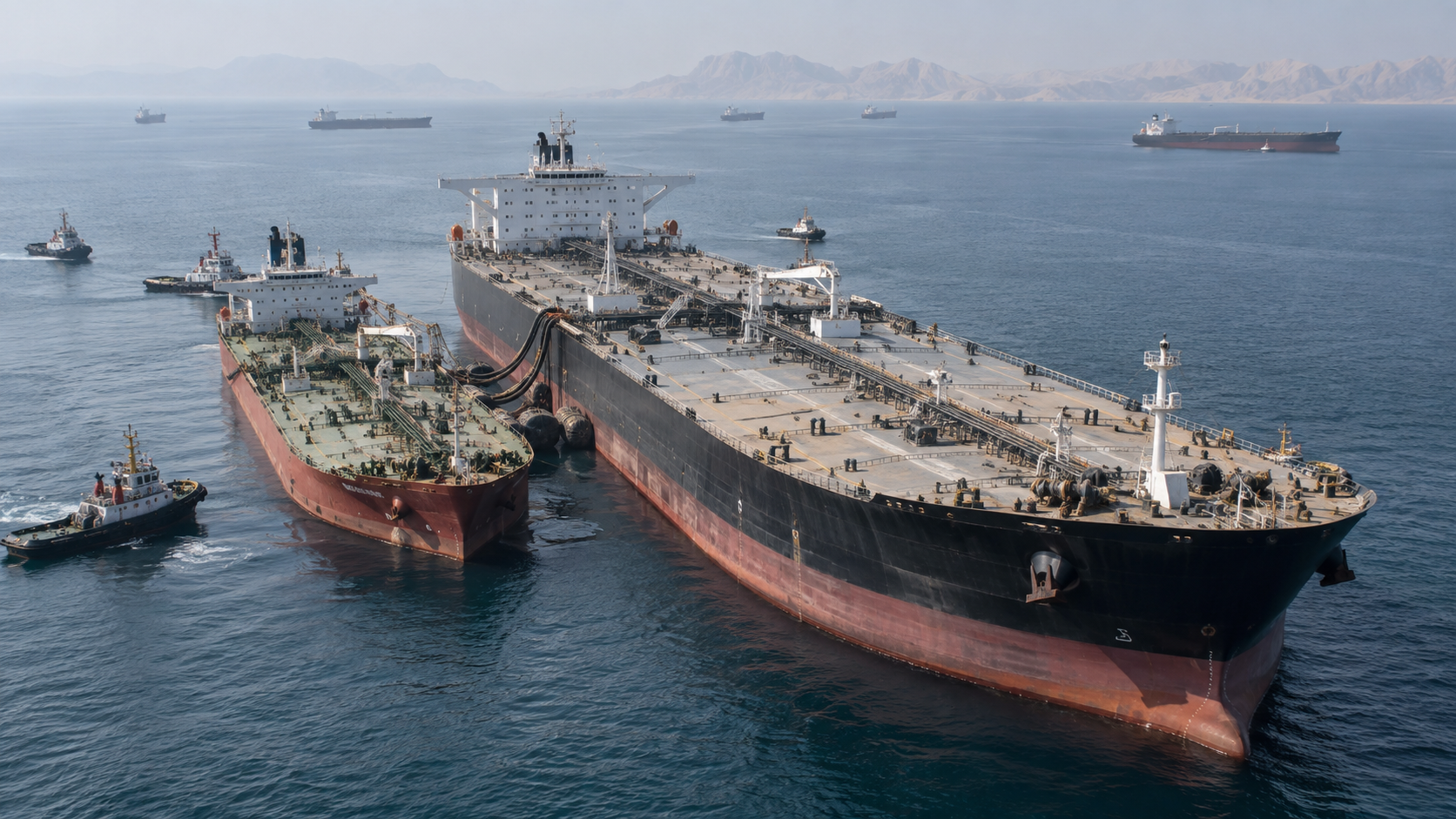
Saudi Aramco has responded by leaning harder on ship-to-ship transfers, in which crude is moved on short trips from Gulf terminals to ports just outside Hormuz and then transferred to larger vessels bound for international markets. Since the pipeline attack, a dozen very large crude carriers have exited Hormuz loaded with roughly 24 million barrels of crude from Ras Tanura, the kingdom's main loading terminal, according to ship tracker Kpler. Aramco has told some European and Asian customers to expect delivery delays or cancellations for September and October if the pipeline is not at least partially restored soon, and people familiar with Aramco's operations say a partial restart within days is possible, though technical hurdles remain. Kpler's lead freight analyst, Matthew Wright, cautioned that the workaround has limits, noting there are signs of only limited additional ship-to-ship transfer capacity available to support more shuttle flows.
The consequence for American drivers is a decoupling that matters heading into the November midterm elections. Adi Imsirovic, a former energy trader and lecturer at the University of Oxford, put the dynamic plainly: "What matters for refiners is the delivered cost of the crude, and that includes freight. The price at the pump includes all of it and the consumer has to pay the full price." That means gasoline prices can stay elevated even if benchmark crude prices ease, because the freight component embedded in the delivered cost of that crude has itself become historically expensive. Natasha Kaneva, head of global commodities strategy at JPMorgan, said the ship-to-ship workaround appears to be functioning for now, but only for as long as Iran allows it to continue, a reminder that the entire arrangement rests on the same geopolitical uncertainty that created the shortage in the first place.