

Something strange is settling into this market. The numbers have never been better and the stocks keep getting punished.
Broadcom posted $29.6 billion in revenue on Wednesday night. That is 86% growth. Earnings beat. Semiconductor revenue more than doubled. And the stock fell 5% after hours because Q4 guidance came in at $34.8 billion, roughly $200 million below what Wall Street wanted. A $200 million gap on a $35 billion quarter.
Meanwhile, Dell closed Wednesday up 15.8% after posting the most extraordinary hardware quarter in recent memory: $47 billion in revenue, $95 billion in AI server backlog, and full-year guidance raised by $25 billion. In the same session, Palo Alto Networks fell 9.3% despite beating on every metric and raising full-year guidance.
The pattern is becoming the story. AI demand is real and accelerating. But the market has priced perfection so precisely that "very good" now costs you 5% to 9% in a single session. The question for September is whether this punishing standard breaks the trade or sharpens it.
ISM Services at 10 AM. Jobless claims at 8:30. NFP Friday. Let's sort through the signals.
Broadcom beat everything except expectations
Broadcom (AVGO) delivered fiscal Q3 results Wednesday after the bell that belong in the highlight reel. Revenue of $29.59 billion, up 86% year over year. Adjusted EPS of $3.32 against the $3.24 consensus. Semiconductor Solutions revenue of $20.84 billion, up 127%. Net income more than tripled to $13.09 billion. Operating margin hit 68%.
And the stock fell 5% in extended trading, settling around $354.
The problem is now familiar. Broadcom guided Q4 revenue at approximately $34.8 billion. Analysts expected $35.03 billion. A $230 million gap on a quarter that implies 93% year-over-year growth. In any other era, 93% growth guidance would cause champagne corks to fly. In this market, it triggers a sell-first instinct because the whisper number was higher.
This is exactly what happened in Q2. Broadcom beat on both lines, declined to raise its AI target above "in excess of $100 billion," and fell 12.6%. The stock never recovered. Investors were sitting in the same position heading into Wednesday: expecting outstanding numbers while bracing for a guidance miss that technically isn't one.
On the earnings call, management laid out something bigger than any single quarter. Broadcom projected AI-related revenue to more than double between fiscal 2026 and 2027, with continued acceleration into 2028. The company disclosed new business with Apple (AAPL) and OpenAI for custom AI accelerators, expanding its XPU customer roster beyond the existing hyperscaler base.
The market signal?
The semiconductor sector posted 142% year-over-year earnings growth last quarter. If you strip semis out of IT entirely, blended growth drops from 75.3% to 38.3%. Broadcom sits at the center of the most concentrated earnings momentum in modern markets. The business is accelerating. The punishment pattern says more about positioning and expectations than fundamentals. If AVGO opens below $355, the pre-Q2 support level of $340 becomes the line to watch.
7 Stocks That Could Become the Market’s Next Giants
Apple, Google, Tesla…
Sure, they’re household names now, but these companies and the other members of the original Magnificent 7 didn’t start out obvious.
They earned their place over time.
Our analysts believe the next generation of market leaders is forming now…
And we’ve identified the 7 companies that fit the “Magnificent” pattern.
You can see the full list for free today
Don’t wait until everyone’s talking about them.
Dell just posted the quarter everyone else wishes they had
While Broadcom absorbed its guidance bruise, Dell Technologies (DELL) had the kind of day that makes hardware investors religious.
Fiscal Q2 revenue: $46.97 billion, up 58% year over year, beating every analyst estimate by over $2 billion. Adjusted EPS: $7.04, against a consensus of $4.92. AI-optimized server revenue hit $16.4 billion. The company booked a record $60.9 billion in AI server orders during the quarter and exited July with a $95 billion AI backlog.
Dell raised its full-year revenue outlook by $25 billion to $192 billion, up nearly 70% year over year. Six months ago, the full-year guide was $165 to $169 billion. The stock closed Wednesday up 15.8%.
COO Jeff Clarke called the AI server business "the most compelling growth opportunity in Dell's history." The AI customer base now exceeds 6,500, with 3,300 added in three quarters. Hewlett Packard Enterprise (HPE) and NetApp (NTAP) rose in sympathy.
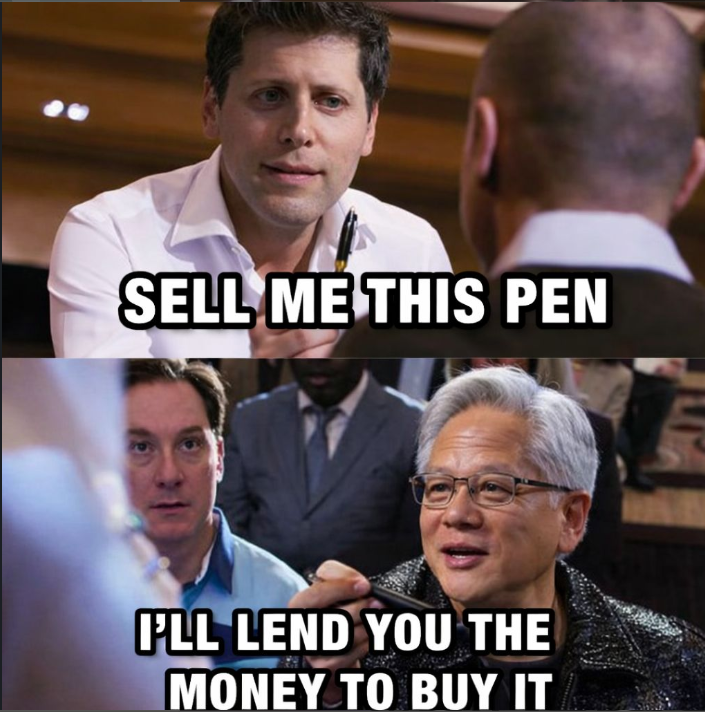
The contrast with Broadcom is instructive. Dell surprised massively and was rewarded. Broadcom confirmed strongly and was punished. The difference is not the quality of the businesses. It is the precision of expectations. In this market, confirmation is not enough.
The market signal?
Dell's $95 billion backlog represents roughly 18 months of AI server revenue at current run rates. That visibility is extraordinary for a hardware company. The question is whether rising DRAM costs and Nvidia GPU procurement pressure compress margins as that backlog converts. Watch gross margins in the Q3 report for the answer.
John Williams just gave the doves something to work with
In an interview Wednesday morning, New York Fed President John Williams said something the bond market had been waiting to hear from a permanent FOMC voter: "We have to wait and see."
Williams acknowledged inflation remains above target but said he sees the trend "moving slowly down as some of the effects of the tariffs kind of move into the rearview mirror." He called the surge in Treasury yields a reflection of economic strength, not market dysfunction, attributing it to "big investments in AI and data centers and technology in general." He explicitly declined to commit to a September hike.
This matters because Williams is not a peripheral voice. As New York Fed president, he holds a permanent vote on the FOMC. Until recently, he was one of the most vocal advocates for holding rates steady. His Wednesday comments, paired with ADP's weak 38,000-job print, shifted the September calculus. CME FedWatch showed hike odds easing from 68% to approximately 57-58% by end of session.
The September 15-16 FOMC meeting is twelve days away. Three dissents voted to hike in July. The August minutes revealed "several" participants wanted to move. Williams essentially told the market: not so fast.
The market signal?
Friday's nonfarm payrolls report is now the swing vote. Consensus expects roughly 53,000 to 56,000 jobs. After ADP's 38,000 miss and two consecutive JOLTS misses, a print below 30,000 likely kills the September hike. A rebound above 80,000 puts it back on the table despite Williams's caution. The labor data picks the winner.
Why are companies flying spy planes over Elon's closely-guarded AI lab?
Elon did the seemingly impossible – far faster than anyone expected...
And it's sent the tech industry into PANIC MODE.
ChatGPT, Claude, Google Gemini, and DeepSeek could soon become obsolete.
And three little-known firms could soar 10X or higher as a result.
Nvidia is buying the open-source AI commons
Bloomberg reported that Nvidia (NVDA) is nearing a $14 billion deal to acquire Hugging Face, the open-source AI platform where developers share, test, and download models. The agreement, which could be signed this week, includes $12.9 billion for the company and a $1 billion retention package for employees.
Hugging Face was valued at $4.5 billion three years ago. Nvidia is already a backer, alongside Alphabet, Amazon, Intel (INTC), and Salesforce (CRM).
This deal is different from Nvidia's compute plays. Hugging Face is the GitHub of AI models: the platform where hundreds of thousands of developers collaborate on open-source machine learning. Owning it extends Nvidia from hardware into the software ecosystem itself, creating a direct relationship with the developer community.
The defensive logic is just as important. A strong open-source ecosystem keeps the market tied to Nvidia's CUDA stack. Every model shared on Hugging Face tends to be optimized for Nvidia GPUs. Owning the platform means shaping that optimization directly.
The market signal?
Nvidia gained 3.12% Wednesday, its best session of the week. The Hugging Face deal would be the most strategically significant AI acquisition of the year. If signed, watch the open-source AI ecosystem companies closely. Nvidia just signaled that the model layer, not just the chip layer, is worth owning.
Palo Alto beat, raised, and lost $12 billion anyway
Palo Alto Networks (PANW) reported fiscal Q4 results Tuesday night that, by any traditional standard, were excellent. Revenue of $3.41 billion, up 34%, beating the $3.35 billion estimate. Adjusted EPS of $1.02, above the $0.98 consensus. Full-year FY27 guidance of $14.1 to $14.2 billion, above the $13.79 billion Street estimate. Next-generation security ARR surged 63% to $9.1 billion.
The stock fell 9.3% on Wednesday, its worst session since February 2024. Roughly $12 billion in market cap erased.
The culprit: a 100-basis-point compression in gross margins from acquisition integration costs and lower-margin platform deals. CEO Nikesh Arora told CNBC that AI-driven security demand is a "long-term tailwind" that "will not happen in one quarter."
The pattern echoes Zscaler's 26% drop in May on a $1 million guidance miss and Broadcom's 5% decline on a $230 million guidance shortfall. Beat on everything, slip on one metric, and the premium collapses.
The market signal?
Palo Alto's FY27 guidance represents 34% revenue growth from a $10.5 billion base. The business is healthy. But in a market that prices perfection, margin slippage carries a higher tax than revenue misses. For cybersecurity investors, the takeaway is that revenue growth alone does not protect you. Margins are the new gatekeeper.
Landmark Executive Order 14241 Unleashes
TRUMP’S NEW DOLLAR
Republican or Democrat – whether you support or oppose Trump’s New Dollar – every American could soon be forced to use it

Discover three critical moves to help you prepare, before it’s too late
- ISM Services PMI for August releases at 10 AM ET. July came in at 54.1. The services sector has now expanded for 25 consecutive months, but the Prices Paid subindex has been above 70 for four of the past five months. A reading below 53 would be the first meaningful deceleration in services activity this year and would shift the inflation narrative from "broad-based" to "concentrated in energy." A print above 55 keeps the hawks armed heading into NFP Friday.
- Weekly initial jobless claims drop at 8:30 AM, expected around 205,000 versus 203,000 prior. After ADP's 38,000 miss and the JOLTS deterioration, any upside surprise in claims would add pressure to the labor-crack thesis. Lululemon Athletica (LULU) and Ciena (CIEN) report after the close, the former as a consumer discretionary read and the latter as an optical networking proxy for data center buildout.
- The market signal across all three?
- Today is the penultimate data day before Friday's NFP. ISM Services and claims together will either reinforce or complicate the picture Williams painted Wednesday: an economy strong enough to hold, with inflation trending slowly lower. If that picture holds, the September hike stays a coin flip. If it cracks, Friday's payrolls report arrives into a market already leaning dovish.
That's it for today's Slate. ISM Services at 10. Claims at 8:30. NFP Friday. The week's verdict is still being written. Stay close.
Today's reply prompt: Dell or Broadcom at current prices, and why?
Tickers: MS ISM NFP AVGO EPS AAPL XPU DELL COO HPE NTAP DRAM GPU FOMC ADP CME JOLTS PANIC MODE NVDA INTC CRM CUDA PANW ARR CNBC TRUMP PMI ET LULU CIEN POLL