

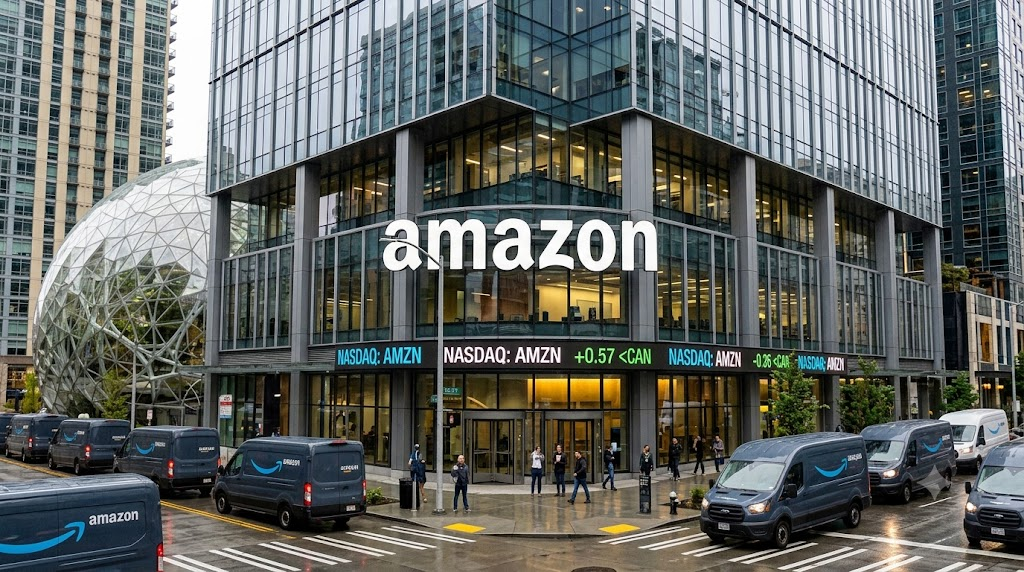
Most companies acquire suppliers. Amazon does something stranger. It buys the right to acquire them later, and only if they perform. In the past year alone, Amazon has embedded equity warrants into over $68 billion in procurement contracts, from AI chips to backup generators. It's a financial structure that looks like a supply agreement, acts like a venture capital fund, and answers to nobody. You have probably never heard of it. That changes today.
But before we get to that, here is a quick look at the markets and what matters this morning…
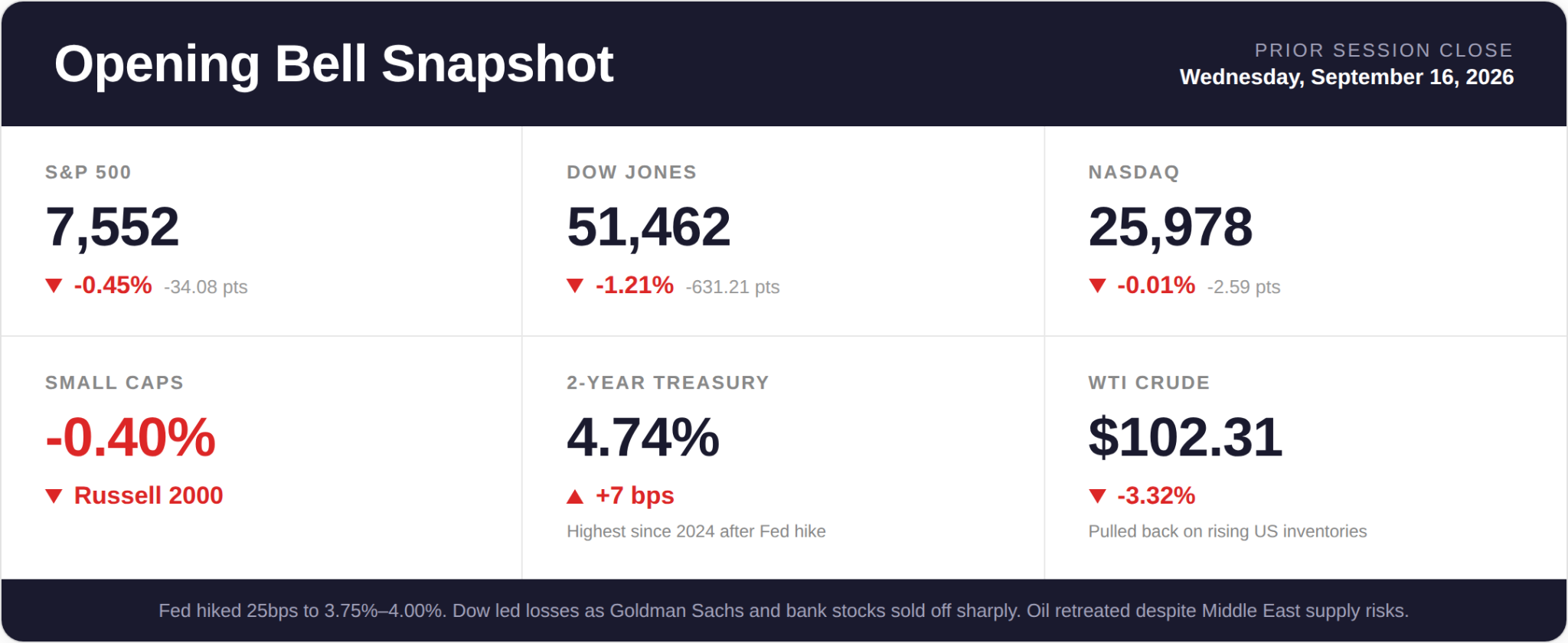
3 Movers in 3 Minutes
- Fed Hikes Into a Storm. The Federal Reserve raised rates by 25 basis points to a 3.75%-4.00% range on Wednesday, its first hike in three years. Chairman Kevin Warsh's press conference spooked markets further when the dot plot showed at least one more hike expected this year. The Dow shed 631 points, with Goldman Sachs (GS) falling 3.9% and bank stocks posting their worst day since February.
- Intel Jumps on SK Hynix Chip Talks. Shares of Intel (INTC) rose 4% after it was reported that South Korea's SK Hynix is in talks to manufacture memory chips at Intel's long-delayed Ohio facility. Options on the table include leasing part of the plant or forming a joint venture with major cloud providers. Nothing is finalized, but for Intel's struggling foundry business, a marquee client like SK Hynix would be transformational.
- Generac Erupts After-Hours on Amazon Power Deal. Generac Holdings (GNRC) surged over 40% in extended trading after disclosing an agreement to supply Amazon (AMZN) with backup power generators for data centers. The deal is worth up to $8 billion, with $2.4 billion in initial deliveries expected in 2027 and 2028. Amazon also received warrants to purchase up to $340 million in Generac stock.
3 Signals for Today
Housing Starts and Building Permits (8:30 AM ET) land this morning, offering a read on whether the construction sector is holding up under 5% mortgage rates and rising material costs.
The Philadelphia Fed Manufacturing Survey (8:30 AM ET) will give the first post-hike read on factory sentiment in the Mid-Atlantic region, a closely watched early indicator for the broader ISM report.
Generac Holdings (GNRC) opens for regular trading after a 40%+ after-hours surge on the Amazon deal. Watch whether the gap holds or fades as institutional traders digest the warrant structure and capex implications.
Buy This $5 Stock Before Elon Musk Does
Rumors are spreading quickly...
Elon is gearing up to buy a tiny, publicly traded company.
Why? Because it holds the exclusive rights to a $16 trillion MOTHERLODE of the exact materials his empire runs on... rare metals like cobalt, manganese and lithium.
On January 1st, a new Pentagon rule cuts off his Chinese supply.
Today, it's a $5 stock... but once Elon makes his move, it could soar to $50 within 6 months.
And with that out of the way, here is the big story this morning: the financial weapon hiding inside Amazon's supply chain.
The Sip
The $340 Million Filing Nobody Expected
After the closing bell on Wednesday, a routine 8-K filing hit the SEC's servers. Generac Holdings, best known for making the backup generators that keep American homes running during storms, disclosed a long-term supply agreement with Amazon.
The headline number was staggering. Up to $8 billion in total payments for backup generators powering Amazon's data centers, with $2.4 billion in initial deliveries over the next two years.
But buried inside the filing was something more interesting than the supply deal itself. Amazon had received warrants to purchase up to 1.69 million shares of Generac's stock at $200.93 per share, roughly $340 million worth of equity that vests in tranches as Amazon spends money on generators.
Generac's stock surged over 40% in after-hours trading.
To the casual observer, it looked like a massive customer deal with a sweetener attached. But this was not a one-off. This was a pattern. And the pattern reveals something that almost nobody is talking about.
Amazon's Procurement Department Is a Venture Capital Fund
Eight days before the Generac deal, Amazon had done the exact same thing with Qualcomm (QCOM).
In that deal, Qualcomm issued warrants to Amazon for 25 million shares at $161.26 per share, a warrant position worth roughly $4 billion, tied to up to $60 billion in purchases of custom AI data center chips. Qualcomm's stock jumped 3% on the announcement.
Five months before that, in April, Oracle (ORCL) received a $400 million warrant to buy Bloom Energy (BE) stock, attached to a 2.8-gigawatt fuel cell agreement for AI data centers. Bloom Energy shares rose 22% in a single session.
In August 2025, Amazon issued warrants to electronics manufacturer Flex (FLEX) for nearly 3.9 million shares. In March 2025, it did the same with optical networking firm Fabrinet (FN), issuing warrants for 381,922 shares. Before that, it was contract manufacturer Jabil (JBL). And before that, air cargo operator ATSG, hydrogen supplier Plug Power (PLUG), and semiconductor firm Astera Labs (ALAB).
As CNBC noted, Amazon "frequently purchases warrants and takes stakes in its suppliers."
Frequently is an understatement. Amazon has turned its procurement department into what may be the most consequential venture capital operation in corporate America.
How the Machine Works
The structure is elegant and, for Amazon, almost riskless.
Here is what happens. Amazon signs a large, multi-year supply agreement with a company it needs. The supplier agrees to issue warrants to Amazon, giving it the right to buy stock at a fixed price. Those warrants do not vest upfront. They vest in tranches, triggered only when Amazon actually makes purchases. The more Amazon buys, the more stock it can claim.
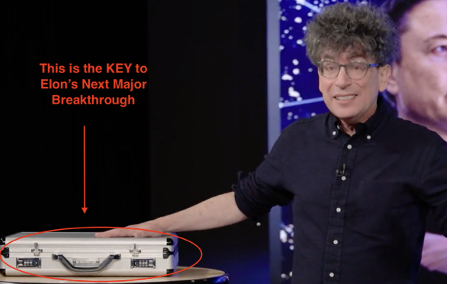
Renowned tech investor James Altucher – the man who called the rise of Nvidia, Apple and SpaceX years in advance – just uncovered Elon Musk’s latest breakthrough idea…
And according to James, it’s going to be even bigger than the SpaceX IPO – creating up to 1.8 million new millionaires over the coming years.
The pieces behind it are inside this briefcase – which he reveals 100% FREE in this video.
For the supplier, the calculus is obvious. A guaranteed customer with the scale and creditworthiness of Amazon, often worth billions in annual revenue. The warrant is a cost of doing business, a small equity concession to lock in the most powerful buyer on Earth.
For Amazon, the calculus is even better. It secures its supply chain. It locks in pricing. And if the supplier performs, Amazon gets to buy stock at yesterday's price, capturing the upside that its own contracts helped create. No bidding war. No premium. No regulatory approval. No board seats.
It is private equity without the fund, venture capital without the pitch deck.
Why This Matters Now
The acceleration in 2026 is not accidental. Amazon Web Services is in the middle of an unprecedented infrastructure buildout. It signed a $38 billion cloud deal with OpenAI late last year. It opened an $11 billion campus for Anthropic last October. And every new data center needs chips, power, cooling, optical networking, and physical infrastructure.
Instead of building all of that in-house or acquiring suppliers outright, Amazon is doing something more subtle. It is financializing its procurement function. Every purchase order doubles as an investment. Every vendor relationship becomes a portfolio position.
The combined value of Amazon's recent warrant-linked deals, Qualcomm alone is worth up to $60 billion in purchases, represents a scale of capital deployment that rivals some of the largest private equity firms in the world. Except Amazon does not have to raise a fund, hire deal teams, or sit on boards. It just buys what it already needs and picks up equity along the way.
The Risks Nobody Is Pricing
For suppliers, the warrant structure is not entirely benign.
From an accounting perspective, the fair value of the warrant is recognized as a reduction to revenue over the vesting period. That means a portion of what Amazon pays is not truly revenue at all, it is effectively buying its own equity position back through inflated contract terms. The optics of a massive deal can mask the dilutive cost embedded inside it.
There is also a dependency problem. Once a supplier structures its business around Amazon-scale orders, walking away becomes nearly impossible. The warrant aligns incentives in theory. In practice, it binds the supplier to a single customer with enormous leverage.
And if a supplier underperforms? Amazon's warrants simply do not vest. It loses nothing. The downside is entirely on the other side of the table.
Nvidia poured over $7B into this
Take a look at this…

It's a radical "light-speed" device that's turning AI as we know it into "Accelerated AI", making it 100 times faster and 100 times more energy efficient.
In fact, Jensen Huang, Nvidia's founder and CEO, says this device is shattering the limitations of AI and without it, AI can't scale.
If you want to discover what this technology is, why Nvidia is betting billions on it…
And the one stock we believe could be the biggest winner when "Accelerated AI" goes mainstream…
The MarketSipsTakeaway
The most important investor in Silicon Valley's supply chain is not Sequoia Capital or Andreessen Horowitz. It is Amazon's procurement department. What started as a clever way to lock in delivery van orders has become a systematic financial strategy deployed across chips, power, manufacturing, and logistics.
In 2026, with AI infrastructure spending accelerating and data centers multiplying, Amazon has found a way to capture equity upside in the very companies building its empire, all without filing a single acquisition. It is a business model innovation hiding inside a filing cabinet. Watch for this structure to proliferate as Microsoft, Google, and Meta realize what Amazon already figured out: the best time to invest in your supply chain is before the rest of the market notices it exists.
Until then, sip slowly!
The Market Sip Desk
Reply prompt: What do you think Amazon's warrant strategy is really about?
FREE FINANCIALMARKETS.COM ALERTS
The Next Market Move Could Start With One Alert
Get breaking market developments, trade ideas, analyst signals and upcoming catalysts sent directly to your phone.
Markets move quickly. Now your information can too.
Tickers: UI MS GS SK INTC GNRC AMZN ET ISM QCOM ORCL FLEX FN JBL ATSG PLUG ALAB CNBC COM START POLL