

Nvidia has spent the last three years being the one company in AI that everyone trusts. It sells chips to OpenAI, Google, Meta, xAI, Anthropic, and a hundred startups in between. It never plays favorites. It never competes. That neutrality is worth trillions. Now Jensen Huang is reportedly ready to risk it for a $25 billion bet on a model company most people have never heard of. Why would the most valuable arms dealer on earth want to start firing shots?
But before we get to that, let's take a quick look at the markets and what matters today...
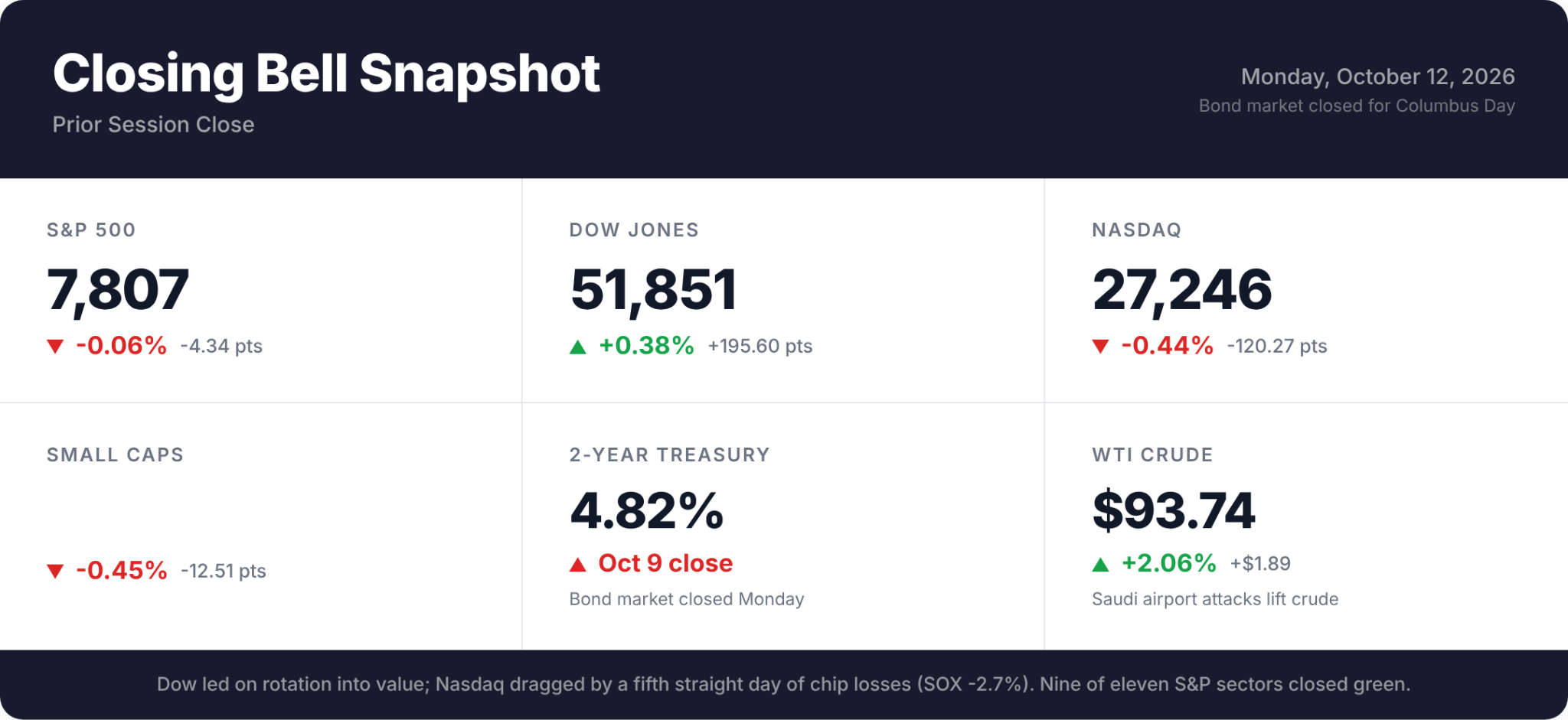
3 Movers in 3 Minutes
- Nvidia circles $25B Reflection AI deal. Nvidia (NVDA) is in early-stage talks to acquire Reflection AI, the open-weight model startup valued at $25 billion. Nvidia already holds an $800 million stake in Reflection, which launched its 501-billion-parameter Beam model earlier this year. A full acquisition would mark the chipmaker's biggest push yet into the model layer and its second major AI talent deal after the Groq acqui-hire last December.
- Bumble explores going private. Bumble (BMBL) confirmed it is in discussions with private equity firms about a potential take-private transaction, sending shares up 12% after hours Friday. The dating app has struggled since its 2021 IPO, with the stock down more than 70% from its debut price. Blackstone and Advent International are among the firms reportedly circling the company.
- Amazon in talks to acquire video AI startup Decart for $7B. Amazon (AMZN) is in talks to acquire Decart, the Israeli startup behind the real-time video generation model Oasis. The deal will give Amazon a generative video engine to embed across Prime Video, Twitch, and AWS.
3 Signals for Today
JPMorgan (JPM), Wells Fargo (WFC), and Citigroup (C) kick off bank earnings season before the bell, with net interest income guidance as the key figure to watch.
The September NFIB Small Business Optimism Index drops today, a leading read on Main Street sentiment ahead of Wednesday's CPI print.
ASML (ASML) reports Wednesday, but its newly announced 10% price hike on EUV lithography machines is already rippling through the semiconductor supply chain. Watch for downstream margin commentary from chip names this week.
The markets are in a dramatically different place than they were in January.
The Fed is raising rates. Geopolitical instability and energy prices are pushing inflation up.
But S&P 500 earnings growth is still expected to continue — and our analysts have identified 10 stocks well-positioned to perform through Q4 and into year-end.
From tech powerhouses to fuel cell makers to reliable dividend growers — all 10 vetted by MarketBeat's analysts and featured in our just-updated 10 Best Stocks to Own: Fall 2026 report.
Tickers, trends, and growth potential. Yours free.
And with that out of the way, let's get to today's big story: the moment Nvidia stopped being neutral.
The Sip
The Deal That Changes the Map
Nvidia is the most important company in artificial intelligence. Not because it builds AI. Because it builds the thing every AI company needs to build AI.
That distinction has been worth $3.6 trillion in market value. Jensen Huang's company controls roughly 90% of the data center GPU market. Every frontier lab, from OpenAI to Anthropic to Google DeepMind, runs on Nvidia silicon. Every sovereign AI initiative, from the UAE to France to Saudi Arabia, writes checks to Nvidia first. The company's fiscal 2026 revenue hit $215.9 billion, more than tripling in two years. Its most recent quarter alone cleared $96.2 billion.
The entire model works because Nvidia is Switzerland. It sells to everyone. It competes with no one. Every customer trusts that their supplier is not also their rival.
Now that trust is about to be tested.
The Target Nobody Saw Coming
It was reported Friday that Nvidia is in early-stage discussions to acquire Reflection AI, the San Francisco-based startup led by former DeepMind researcher Misha Laskin. The deal could value Reflection at roughly $25 billion, a figure that sounds staggering until you realize Nvidia already invested $800 million into the company during its April funding round.
Reflection is not a typical AI startup. It launched Beam, a 501-billion-parameter open-weight model that directly competes with Meta's Llama and, on several benchmarks, matches or outperforms closed models from OpenAI and Anthropic. The company has raised approximately $2.6 billion in total from Nvidia, Sequoia Capital, and Lightspeed Venture Partners. Its pitch from the start has been that open-weight models will win the long game, and that the best way to build them is to work hand-in-glove with the hardware maker.
That pitch now has a price tag: $25 billion for Nvidia to own the model outright.
Why Neutrality Was the Product
To understand why this matters, you need to understand what Nvidia is actually selling. It is not just GPUs. It is CUDA, the software platform that locks developers into Nvidia hardware. It is networking gear, DGX systems, cloud partnerships, and an entire stack designed so that switching away from Nvidia is so painful that almost nobody does.
That lock-in works because every customer believes the relationship is purely transactional. You buy our chips, we make them faster, everyone wins. The moment Nvidia owns a frontier model, every other model company has to ask: is Nvidia going to optimize its chips for its own model first? Will Reflection AI get early access to next-generation Blackwell Ultra chips? Will Nvidia's model team see proprietary performance data that competitors never will?
There's a HUGE Downside to This Bull Market (And It's Not a Crash)
It's hard to deny we're in a bull market.
Stocks, real estate, gold, and bitcoin are hitting record highs month after month.
But one multi-millionaire investor says this is unlike any bull run we've seen before.
"There's a dark reason why so many assets are levitating—it's a sign we've entered the Most Terrifying Bull Market in History."
For the full story, click here.

These are not hypothetical concerns. When Google builds its own TPU chips, one reason is precisely to avoid depending on a supplier who might one day become a rival. Microsoft invested $13 billion in OpenAI partly to secure a model layer it controls. The entire AI industry is organized around the fear of vertical integration by a dominant player.
Nvidia buying Reflection AI is exactly that scenario.
The Groq Precedent, and What Comes Next
This would not be Nvidia's first move into the model layer. In December 2025, Nvidia completed what was widely described as an acqui-hire of Groq, the inference chip startup, in a deal worth roughly $20 billion. That transaction was framed as a talent acquisition, bringing specialized chip architects in-house to accelerate Nvidia's own inference hardware roadmap.
Reflection AI is different. Beam is a production model with real users, real benchmarks, and a real competitive position. It has been deployed by enterprise customers across healthcare, legal, and financial services, segments where open-weight flexibility matters more than brand-name prestige. Acquiring it would not be an acqui-hire. It would be a declaration. Nvidia would go from the company that powers AI to a company that builds AI and powers AI.
The strategic logic is not hard to see. The GPU business is cyclical. Export controls have already cost Nvidia billions in China revenue. AMD, Intel, and a wave of custom silicon from Google, Amazon, and Microsoft are chipping away at the hardware moat. Owning a model gives Nvidia a second engine, a recurring software revenue stream, and a reason for enterprises to buy the full Nvidia stack rather than just the chips.
But the cost is neutrality. And neutrality is what built the $3.6 trillion empire in the first place. Every dollar Nvidia earns from Reflection's competitors becomes a dollar those competitors now have reason to question.
The talks are early. The deal structure remains unclear: it could be a full acquisition, an expanded stake, or something resembling the Groq playbook. But the signal is unmistakable. Jensen Huang has looked at the AI market and concluded that selling shovels is no longer enough.
People paid $8,000… yours for FREE

Some people have paid $8,000 to be in the room with Luke Lango in Las Vegas. But he believes the new Elon venture he's uncovered (not space or AI) is so big that EVERYONE needs to know about it. See how to get in while we're still early here.
This ad is sent on behalf of InvestorPlace Media at 1125 N. Charles Street, Baltimore, Maryland 21201. If you're not interested in this opportunity, pleaseclick here.
The MarketSips Takeaway
Watch how Nvidia's biggest customers react this week. The real tell is not the deal price or the timeline. It is whether hyperscalers like Microsoft (MSFT), Google (GOOGL), and Amazon accelerate their custom chip programs in response. If Nvidia crosses the neutrality line, the customers who spent billions on its hardware have every incentive to diversify away faster. The $25 billion question is not whether Nvidia can afford Reflection AI. It is whether it can afford to lose the trust that made it indispensable.
Until then, sip slowly!
The Market Sip Desk
Reply prompt: Would you trust Nvidia to stay neutral with your AI stack if it owned a competing model?
3 Market Signals Most Investors Aren't Watching
The headline is usually the last place the story shows up.
By the time everyone is talking about a stock… the signals underneath it may have been changing for weeks.
• Institutional money moves.
• Options activity changes.
• Management confidence shifts.
• Fundamentals improve, or quietly begin telling a different story.
That’s exactly what our analysts found in three stocks where the evidence stopped agreeing with itself.
And in all three cases, the story is still developing.